Resources
Genetic Genealogy
Sculpture Art on Eastside Trail near Ponce Market in Atlanta, Georgia, which depicts a family or group of people.
DNA Testing, which is a vital part of genetic genealogy, is an important tool when researching your ancestors. Many people test to discover their heritage (as shown below). While interesting, more value from a research perspective is the ability to connect to your DNA Matches. Some of the closer relationships (measured in centimorgans (cMs) will be people you may know. The true value though is through discovery of other’s trees.
One of my first connections was to a 2nd cousin. We shared grandfathers who were brothers; mine, the oldest and hers, the youngest, 25 years apart. Through this wonderful connection, I was introduced to a photograph of my great-grandparents who I had never met! My cousin, just as excited about genealogy as me, shared memories, ancestor information she had gathered, and photographs. And through this connection, we now have a friendship that was made possible through DNA testing.
Check the links and materials below to help you in your DNA journey. Reach out if you would like help!
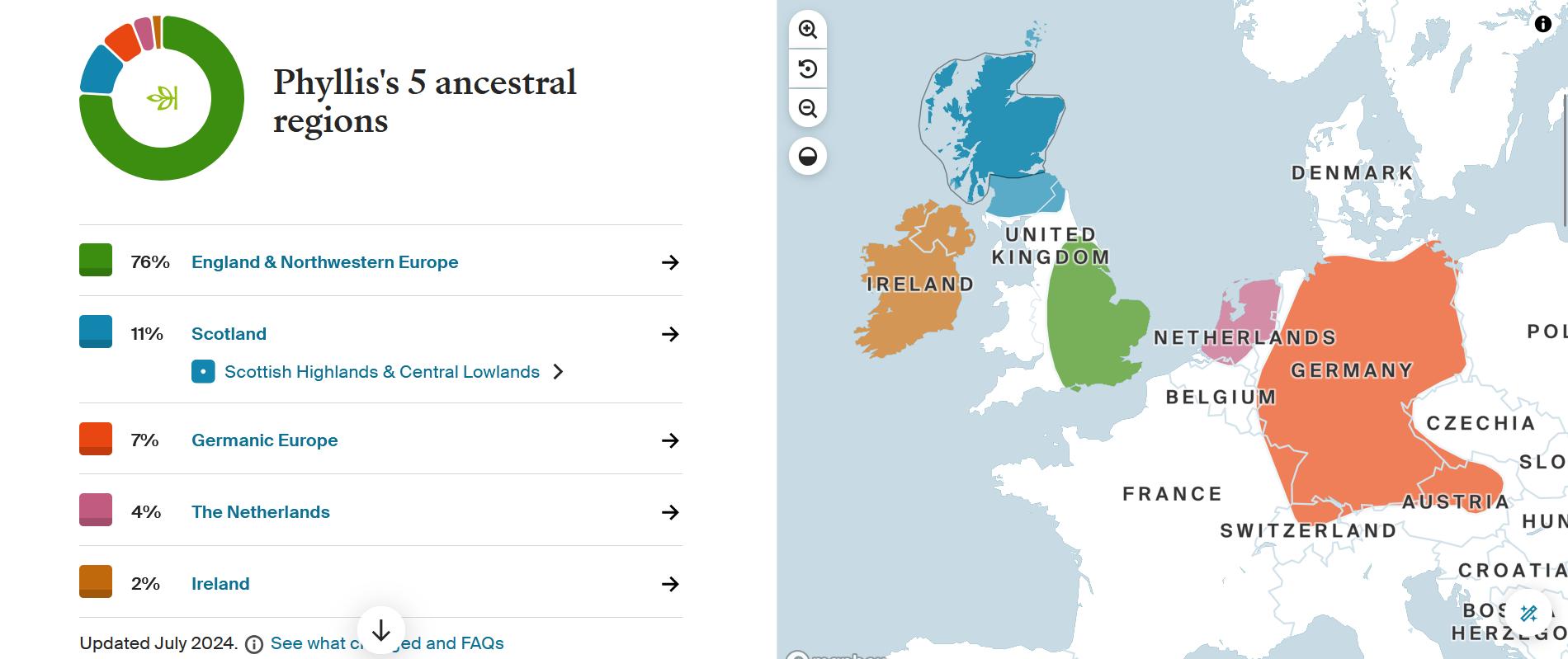
Images. Screen Capture. My Ancestral Regions. July 2024. Phyllis Zumwalt, @ Ancestry.com.
What is DNA?
DNA, short for Deoxyribonucleic Acid, is defined as “…the molecule that carries genetic information for the development and functioning of an organism.” It is composed of two linked winding strands (visualize a spiral staircase), called a double helix, with these 4 nucleotide bases; adenine (A), cytosine (C), guanine (G) or thymine (T). These four bases pair are:
- adenine binding with thymine, or A-T, T-A.
- cytosine binding with guanine, or C-G, G-C.
See National Human Genome Research Institute, NIH. https://www.genome.gov/genetics-glossary/Deoxyribonucleic-Acid.
Types of DNA Testing:
There are three main types of DNA testing: autosomal (atDNA), mitochondrial, for the matrilineal line (mtDNA), and Y-DNA (for the patrilineal line). We will discuss these in detail next week. Comparison charts for each type of testing:
|
atDNA |
https://isogg.org/wiki/Autosomal_DNA_testing_comparison_chart |
|
mtDNA |
|
|
Y-DNA Testing |
Other Links on Genetic Genealogy
SERVICES:
AncestryDNA https://www.ancestry.com/c/dna/what-to-expect-ancestrydna-test.
23andMe DNA https://www.23andme.com/dna-ancestry/.
FTDNA (can upload DNA data from AncestryDNA or 23andMe DNA). https://www.familytreedna.com/.
MyHeritage (can upload DNA data from AncestryDNA or 23andMe DNA). https://blog.myheritage.com/2021/11/myheritage-dna-everything-you-wanted-to-know-about-the-myheritage-dna-test/.
GEDMatch (can upload DNA data from AncestryDNA or 23andMe DNA). https://www.gedmatch.com/.
WEBSITES:
ISOGG. Choosing a DNA testing company. ISOGG wiki. https://isogg.org/wiki/Choosing_a_DNA_testing_company.
DNA painter. https://dnapainter.com/.
Estes, Roberta. (2018) The Leeds Method. https://dna-explained.com/2018/10/02/dnapainter-painting-leeds-method-matches/.
Leeds, Dana. (2024) The Leeds Method. https://www.danaleeds.com/the-leeds-method/.
BOOKS:
Bettinger, Blaine. (2019) Family Tree guide to DNA testing and genetic genealogy. 2nd ed. Fort Collins, Colorado: Family Tree Books. ISBN: 978-1440300578.
Holton, Graham S., ed. (2019) Tracing your ancestors using DNA: a guide for family historians. Barnsley: Pen and Sword. ISBN: 978-1526733092.
Get in touch!
shapingyourfamilytree@gmail.com
Master of Science (Distinction), Genealogical, Paleographical and Heraldic Studies, University of Strathclyde
Accredited as Qualified Genealogist
Instructor for Genealogy Workshops